
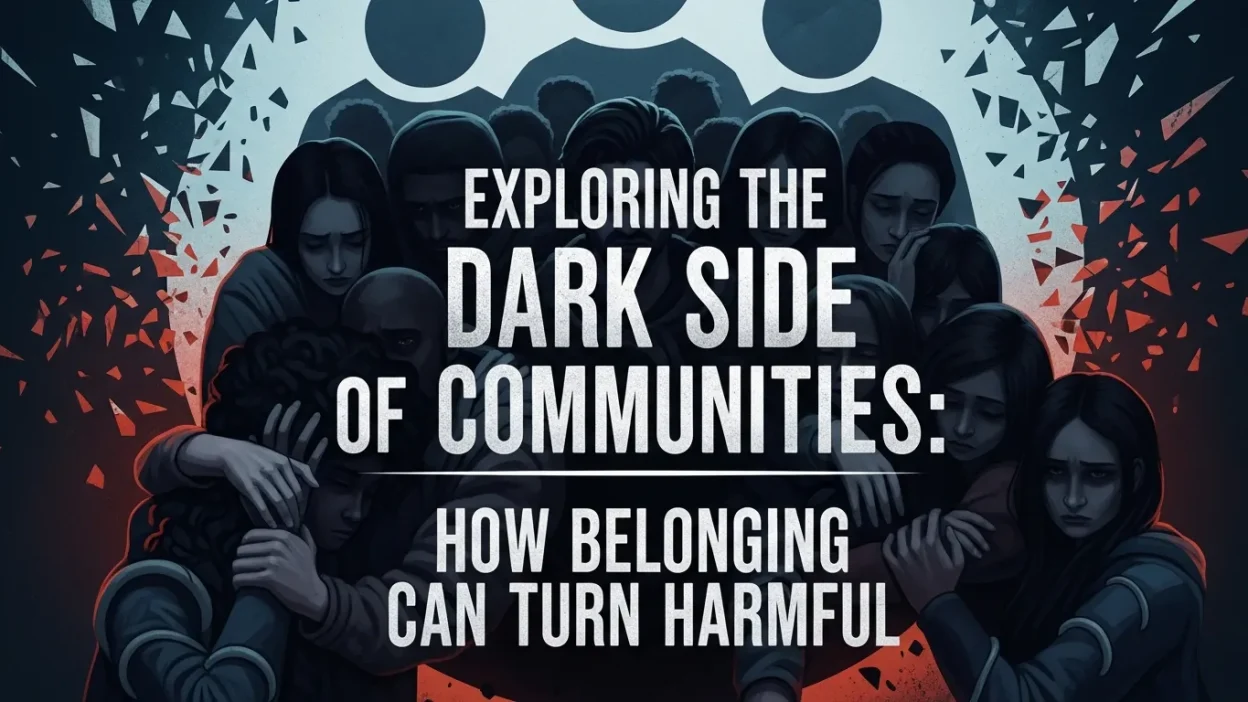
Communities play a vital role in shaping our identities, values, and sense of belonging. However, the dark side of communities emerges when belonging transforms into control, conformity pressures, and toxic dynamics. Members may self-censor, prioritize social status over ethics, or experience reduced individuality. Online spaces are especially prone to echo chambers, reinforcing biases and suppressing dissent. Recognizing and addressing these patterns through transparency, psychological safety, rotation of responsibilities, and exposure to diverse perspectives helps build healthier, resilient communities where differences strengthen rather than fracture the group.
Communities shape our identities, values, and worldviews. They provide belonging, support, and shared purpose, offering spaces where individuals can grow and connect. However, beneath the surface of seemingly positive groups lies a reality that is often overlooked: the dark side of communities. While they can empower, inspire, and sustain, many communities also harbor destructive dynamics that harm their members and society at large. Understanding these hidden dangers is crucial if we hope to build healthier, more resilient connections while avoiding environments that stifle individuality or foster toxicity.
When Belonging Becomes Binding
The very mechanisms that make communities powerful—the shared identity, mutual accountability, and collective values—can, paradoxically, turn into instruments of control. In close-knit groups, differences in opinion are frequently perceived as threats to cohesion. Over time, conformity pressures intensify. Members often self-censor to maintain social standing, sometimes compromising their personal ethics to preserve relationships.
This shift rarely happens overnight. Most communities do not begin with intentions to dominate or restrict. Instead, a natural desire to protect Group Identity with Local Ecological Systems gradually builds rigid boundaries around what is considered acceptable thought and behavior. Leaders, whether intentionally or not, may reinforce these tendencies by rewarding conformity and punishing dissent. The result is a space where authentic expression becomes risky—a hallmark of the dark side of communities.
Research from the Journal of Social and Political Psychology indicates that this process accelerates when communities perceive external threats. Defensive postures harden group boundaries, intensifying demands for loyalty and creating a phenomenon researchers term “ideological encapsulation”—a state where members increasingly isolate themselves from outside perspectives.
Understanding the Dark Side of Communities: Conformity and Control
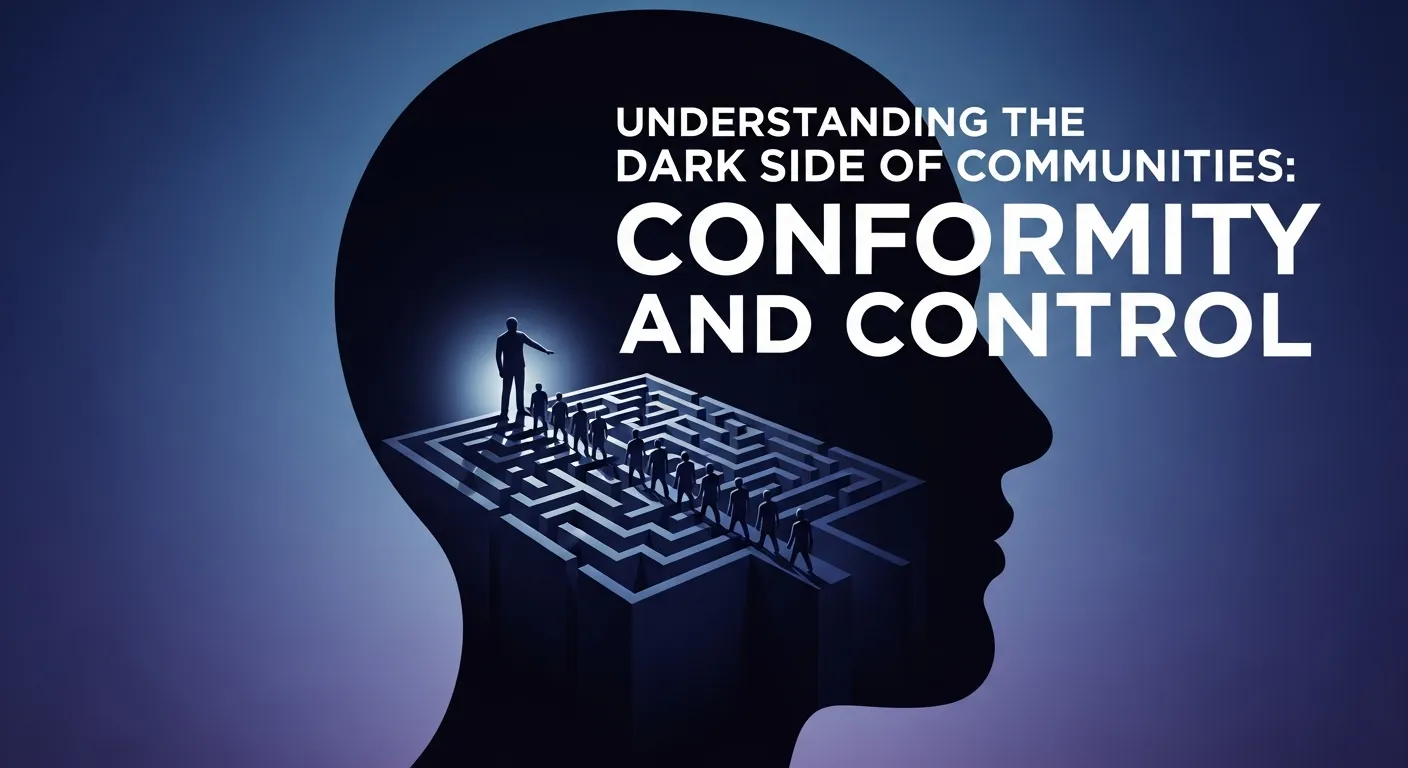
The dark side of communities emerges when belonging turns into control. Members may feel pressured to conform, self-censor, or compromise personal ethics to maintain acceptance. Over time, the very bonds that provide support can also restrict individuality and authentic expression.
Leaders who unintentionally reward conformity can reinforce these tendencies, gradually creating rigid boundaries around what is considered acceptable. Awareness of the dark side of communities is crucial for preventing environments where members feel trapped or silenced.
Key mechanisms of the dark side of communities:
- Conformity pressures restricting personal expression
- Self-censorship to maintain social standing
- Rewarding group loyalty over ethical autonomy
The Echo Chamber Effect
The dark side of communities is particularly visible in modern digital spaces. Online groups often evolve into echo chambers, amplifying existing beliefs while filtering out contradictory information. This distortion occurs through several reinforcing mechanisms:
- Selective exposure: Members encounter information that confirms their preexisting beliefs.
- Social amplification: Ideas repeated within the group gain perceived validity, regardless of factual accuracy.
- Outlier suppression: Contradictory or critical perspectives face disproportionate scrutiny, while conforming views go largely unquestioned.
Neurologically, echo chambers exploit our brain’s natural confirmation bias—the tendency to seek evidence supporting existing beliefs. Communities reinforce this bias, creating chemical rewards for conformity and triggering threat responses when members encounter challenging information. Over time, prolonged exposure to ideologically homogeneous communities can reshape neural pathways, making it harder to genuinely consider alternative perspectives. Research published in Build Bonding highlights that such environments literally alter how we process information, favoring confirming evidence and rejecting contradictory data—a physiological reinforcement of polarized thinking.
The Dark Side of Communities in Digital Spaces
The dark side of communities is highly visible online, where echo chambers amplify existing beliefs and suppress dissenting voices. Members encounter information confirming preexisting opinions, creating perceived consensus and marginalizing alternative perspectives.
Neurologically, this exploitation of confirmation bias reinforces polarized thinking. Communities practicing storytelling as community in balanced ways can counteract these effects, but unmoderated spaces may amplify echo chamber dynamics.
| Mechanism | Effect on Members | Example |
|---|---|---|
| Selective exposure | Reinforces existing beliefs | Members see only like-minded content |
| Social amplification | Validates repeated ideas | Group agreement perceived as truth |
| Outlier suppression | Silences dissent | Contradictory perspectives are discouraged |
The Toxicity Spiral
The dark side of communities also manifests when groups lack proper accountability and conflict resolution mechanisms. Minor interpersonal tensions can escalate into full-blown factional disputes. Leadership struggles often divide loyalties, and unresolved grievances harden into lasting resentment, poisoning interactions across the community.
Studies from the Pew Research Center illustrate how online communities, in particular, are prone to these dynamics. Reduced social cues and asynchronous communication amplify misunderstandings, while assumptions about others’ intentions tend to skew negative. This creates spirals of hostility that are difficult to reverse.
Social status dynamics further exacerbate toxicity. When hierarchy and recognition become the primary currency, members compete rather than collaborate. Conversations shift from authentic exchange to performance, and knowledge hoarding replaces collective learning. In such environments, the dark side of communities is not just a theoretical concept—it actively erodes the value that communities are meant to provide.
How the Dark Side of Communities Creates Toxic Environments
When the dark side of communities dominates, minor disagreements can escalate into deep-rooted conflicts. Power struggles, factionalism, and hierarchy-driven competition erode trust and collaboration, turning supportive groups into toxic spaces.
Members may prioritize social status over meaningful engagement, leading to knowledge hoarding, performative interactions, and reduced collective learning. Recognizing these patterns is essential for mitigating the negative impact of the dark side of communities.
Warning signs of toxicity in communities:
- Escalating conflicts over minor issues
- Leadership struggles causing factionalism
- Competition replacing collaboration
Identifying and Breaking Destructive Patterns

Recognizing these darker dynamics is the first step toward creating healthier communities. Intentional practices can prevent or mitigate harm:
-
Transparency: Open decision-making and clearly documented rules make power concentration difficult, reducing authoritarian drift.
-
Exposure to outside perspectives: Inviting thoughtful criticism and external feedback prevents echo chambers and strengthens the community’s intellectual rigor.
-
Psychological safety: Members must be able to voice concerns without fear of rejection or retaliation. Simply naming unhealthy dynamics Economy Communities to self-correct.
-
Rotation of responsibilities: Circulating leadership and influence fosters broader ownership, prevents entrenched hierarchies, and introduces diverse perspectives.
These practices confront the dark side of communities head-on, enabling spaces that are both cohesive and resilient.
Overcoming the Dark Side of Communities
Addressing the dark side of communities requires intentional strategies that promote transparency, psychological safety, and inclusivity. Open decision-making and rotating responsibilities reduce concentration of power and prevent authoritarian drift.
Exposing communities to external perspectives and fostering safe channels for dissent encourages critical thinking and resilience. By actively managing these factors, communities can transform negative dynamics into opportunities for growth.
Strategies for healthier communities:
- Transparent decision-making and clear rules
- Encouraging external feedback and diverse perspectives
- Rotating leadership to prevent entrenched hierarchies
Building Sustainable Communities
Healthy communities do not seek perfection. Conflict and disagreement are natural and can be constructive when managed well. The challenge lies in balancing cohesion with openness. Too much unity leads to conformity pressures; too little produces fragmentation. Sustainable communities maintain this tension productively, allowing strong shared identity while encouraging meaningful individual expression.
Diversity—of thought, background, and experience—serves as a natural bulwark against groupthink. However, mere diversity is insufficient. Communities must actively integrate different viewpoints into decision-making. Without intentional processes, surface-level diversity can mask a homogeneous mindset.
Ultimately, the goal is not uniformity but resilience. By acknowledging the dark side of communities, we gain the awareness necessary to foster environments where differences strengthen rather than fracture the group.
Transforming the Dark Side of Communities into Strength
Sustainable communities balance cohesion with openness, allowing members to express individuality while maintaining shared purpose. Diversity of thought, background, and experience mitigates groupthink, strengthening the group’s adaptability and problem-solving capacity.
The dark side of communities can be turned into learning opportunities when conflict and disagreement are treated constructively. Resilient communities integrate multiple perspectives into decision-making, enhancing both social and intellectual growth.
Keys to building sustainable communities:
- Encouraging constructive conflict
- Integrating diverse viewpoints into decisions
- Maintaining balance between unity and individuality
Harnessing Awareness of the Dark Side of Communities
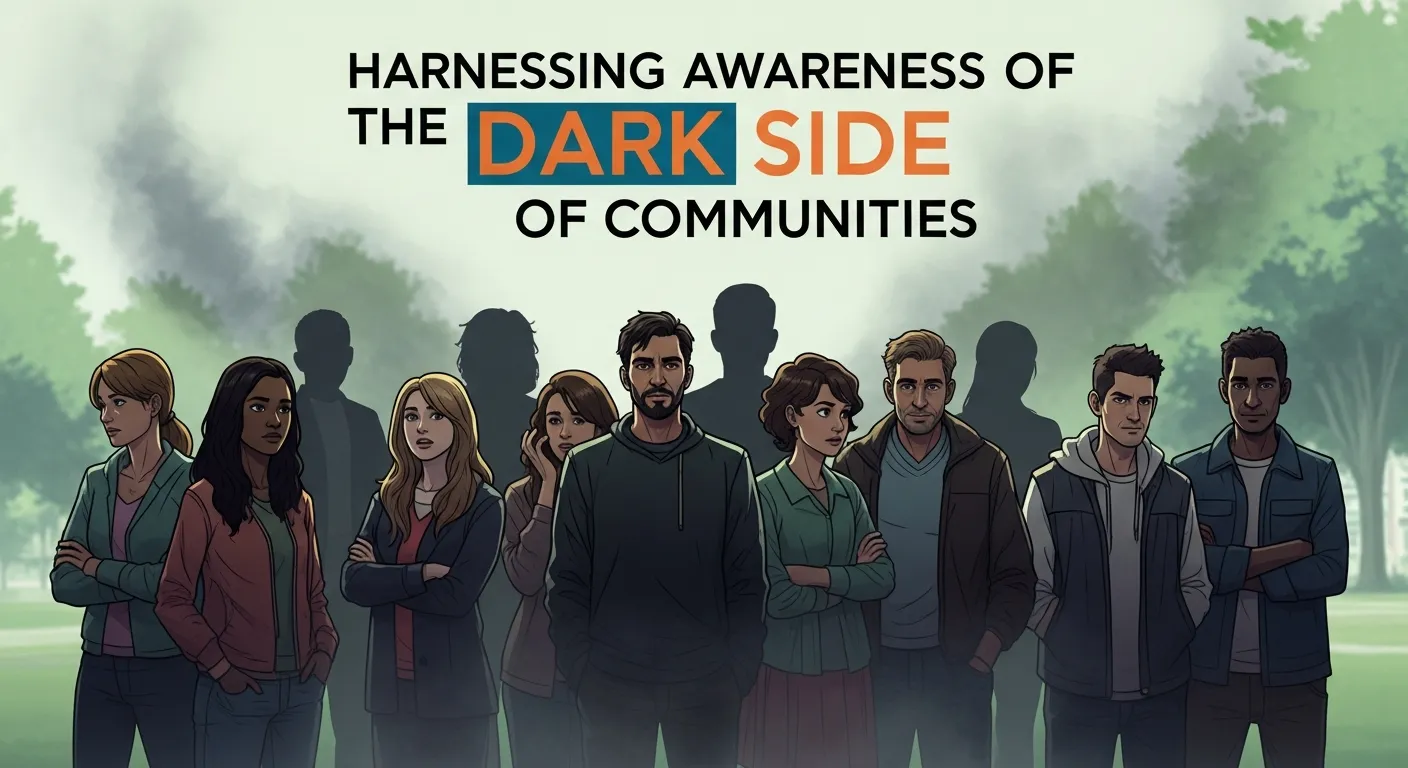
Awareness of the dark side of communities empowers leaders and members to foster healthier, resilient groups. By addressing echo chambers, toxic dynamics, and conformity pressures, communities can unlock their positive potential.
Confronting the dark side of communities transforms social spaces into engines of growth, empathy, and shared purpose. When properly managed, the community becomes a place where members thrive authentically rather than merely conforming.
Takeaways:
- Recognize and mitigate destructive group patterns
- Foster psychological safety and inclusivity
- Transform communities into growth-oriented, resilient spaces
Conclusion: Transforming the Dark Side of Communities into Opportunity
Understanding the dark side of communities allows us to approach social groups with clarity and intention. Belonging need not become binding, nor should shared purpose devolve into conformity and hostility. By addressing toxic patterns, preventing echo chambers, and cultivating transparency and psychological safety, we can create communities that enhance human potential rather than diminish it.
The communities we build shape not only our social interactions but also our cognition, emotional well-being, and moral development. Confronting the dark side of communities empowers us to unlock the positive potential of human connection, creating spaces where people truly thrive rather than merely conform. In doing so, we transform communities into engines of growth, empathy, and shared purpose.
FAQs: Dark Side of Communities
1. What is the dark side of communities?
The dark side of communities refers to the harmful and often hidden dynamics that can arise within social groups. These include pressures to conform, toxic hierarchies, exclusionary practices, echo chambers, and restrictions on personal autonomy. While communities are meant to support members, these negative aspects can limit individuality and even harm members’ emotional or social well-being.
2. How does belonging turn into control?
Belonging can shift into control when the group’s identity and cohesion are prioritized above individual expression. Members may feel pressured to self-censor, avoid dissent, or compromise personal values to remain accepted. Over time, these pressures can restrict authentic communication and create an environment where conformity is rewarded more than ethical decision-making.
3. Why are online communities particularly vulnerable?
Online communities are highly susceptible to the dark side of communities because digital spaces often lack face-to-face accountability. Algorithms, limited context, and asynchronous communication amplify selective exposure, making it easier for members to see only confirming information. This can intensify biases, marginalize dissenting opinions, and reinforce groupthink.
4. What is an echo chamber in a community?
An echo chamber occurs when beliefs and ideas within a community are continuously reinforced while alternative perspectives are ignored or suppressed. This creates a distorted sense of consensus, reduces critical thinking, and can lead members to overvalue the opinions of the group while dismissing outside input, often without realizing it.
5. How does the dark side of communities affect mental health?
Toxic community dynamics—such as hostility, judgment, exclusion, and pressure to conform—can significantly impact mental health. Members may experience stress, anxiety, lowered self-esteem, and a diminished sense of autonomy or belonging. Over time, such environments can contribute to emotional exhaustion or social withdrawal.
6. What role do leaders play in the dark side of communities?
Leaders hold significant influence over a community’s culture. When leaders reward conformity, ignore dissent, or centralize power excessively, they can inadvertently reinforce toxic behaviors. This often results in rigid hierarchies, suppression of alternative perspectives, and a climate where members feel unsafe expressing authentic opinions.
7. How can communities prevent toxic dynamics?
Communities can actively counter harmful patterns through several strategies: fostering transparency in decision-making, cultivating psychological safety where members feel heard, rotating leadership responsibilities to prevent entrenched hierarchies, welcoming external perspectives, and establishing clear mechanisms for conflict resolution and accountability.
8. What are warning signs of the dark side of communities?
Common warning signs include escalating conflicts over minor issues, factionalism and cliques, hoarding of knowledge or resources, performative rather than genuine interactions, suppression of dissenting voices, and excessive pressures to conform. Recognizing these early helps prevent long-term damage.
9. Can diversity prevent the dark side of communities?
Diversity can be a powerful safeguard against toxic dynamics, but only if different perspectives are actively integrated into discussions and decision-making. Superficial diversity without inclusion may mask underlying homogeneity and fail to prevent echo chambers or groupthink.
10. How can members resist the dark side of communities?
Members can resist negative patterns by practicing independent thinking, respectfully challenging group norms, advocating for transparency, supporting psychological safety, and encouraging the inclusion of multiple viewpoints. Constructive engagement helps transform harmful dynamics into opportunities for growth.
11. Why is awareness important?
Awareness of the dark side of communities equips members and leaders to identify harmful behaviors before they escalate. By understanding these patterns, communities can promote resilience, enhance decision-making, and maximize their positive social, cognitive, and ethical impact.
12. Can the dark side of communities be turned into growth opportunities?
Yes. When conflicts, disagreements, and diverse perspectives are managed constructively, what initially appears as the dark side of communities can become a source of learning, innovation, and collective growth. Properly managed, these dynamics strengthen trust, collaboration, and overall community resilience.