

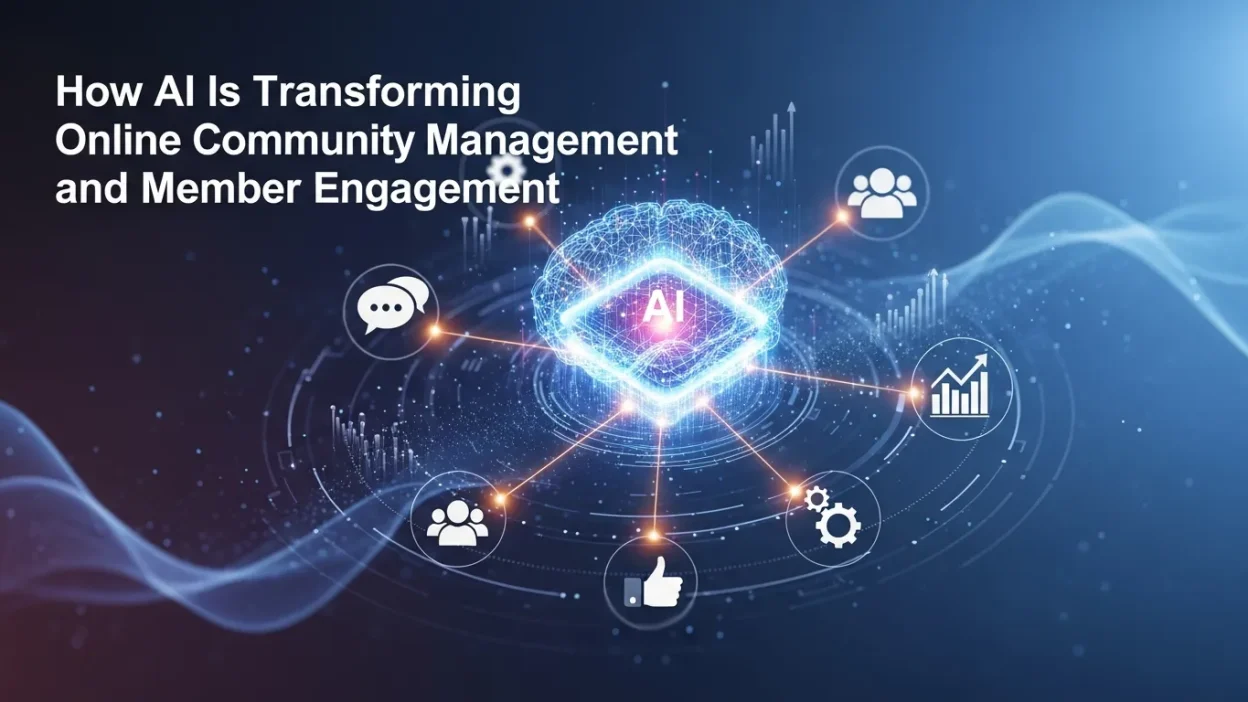
Online Community Management is becoming more efficient and engaging with the use of AI-powered tools. Artificial intelligence helps automate moderation, personalize content, and analyze member behavior to improve engagement and retention. By combining AI efficiency with human oversight, modern communities can scale effectively while maintaining trust, safety, and meaningful member interactions.
The rise of AI-powered community management is transforming how online communities function. Today, community managers leverage artificial intelligence tools to enhance member engagement, streamline moderation, and build vibrant digital spaces. By automating routine tasks, analyzing member behavior, and delivering personalized community experiences, AI helps keep members active and invested.
Online communities face increasing expectations. Members want instant responses, relevant content, and meaningful interactions. Traditional community management techniques often struggle to meet these demands. AI-driven solutions provide a more efficient and effective approach, helping managers stay ahead in delivering value to their audience.
This technological shift benefits communities of all sizes. From niche hobby groups to large corporate platforms, intelligent community management systems allow leaders to understand members more deeply. By generating insights that were previously impossible to capture, AI empowers community managers to make data-driven decisions about content strategies, engagement tactics, and member support initiatives.
The Current State of AI-Powered Community Platforms

AI platforms now power many successful online communities. These systems use machine learning algorithms to understand member preferences and behavior patterns. The technology helps identify trending topics, detect spam, and suggest relevant content to users.
Major social media platforms have led this transformation. Facebook uses AI to curate news feeds and recommend groups. LinkedIn applies machine learning to suggest professional connections and content. Discord employs AI for moderation and community safety.
Smaller community platforms also benefit from AI integration. Tools like Discourse and Circle now offer AI-powered features for independent community builders. These platforms use natural language processing to categorize discussions and highlight important conversations.
The technology continues to evolve rapidly. New AI tools appear regularly, offering more sophisticated community management capabilities. Voice recognition, sentiment analysis, and predictive modeling become more accessible to community managers.
Key AI Applications in Community Management
Automated Member Support and Moderation
Chatbots for community support handle basic member questions instantly. These AI assistants work around the clock, providing immediate help when human moderators aren’t available. They can answer frequently asked questions, guide new members through onboarding, and escalate complex issues to human staff.
AI moderation tools identify and remove inappropriate content automatically. These systems detect spam, harassment, and policy violations faster than human moderators. They use pattern recognition to spot troublesome behavior before it spreads through the community.
Smart filtering systems reduce false positives in content moderation. Advanced AI learns from community-specific contexts and cultural nuances. This reduces the chance of incorrectly flagging legitimate discussions.
Personalized Content and Engagement Strategies
AI analyzes individual member interests to suggest relevant content. Machine learning algorithms track engagement patterns and predict what type of posts will interest specific users. This personalization increases the likelihood that members will participate in discussions.
Recommendation engines help members discover relevant groups and topics within larger communities. These systems analyze member activity to suggest connections with like-minded individuals. The technology facilitates natural relationship building between community members.
Dynamic content curation ensures members see the most engaging discussions first. AI algorithms consider factors like recency, popularity, and personal relevance when organizing community feeds. This keeps active conversations visible while preventing important updates from getting buried.
Member Behavior Analytics and Insights
Member behavior analytics reveal patterns in community engagement. AI tracks metrics like posting frequency, response times, and topic preferences. This data helps community managers understand what drives member participation.
Predictive analytics identifies members at risk of leaving the community. Machine learning models analyze engagement drops and participation patterns to flag potential churn. Early intervention strategies can then be deployed to re-engage these members.
Sentiment analysis monitors overall community health and satisfaction. AI tools scan conversations to gauge member mood and identify potential issues. This helps managers address problems before they escalate into larger conflicts.
AI-Powered Onboarding for New Community Members
First impressions matter in online community management. AI-powered onboarding ensures that new members feel welcomed, informed, and confident from the moment they join. Instead of generic welcome messages, AI tailors onboarding journeys based on user profiles, interests, and goals.
By guiding members through relevant content and community norms early on, AI reduces confusion and increases long-term engagement. This structured introduction helps new users quickly find value in the community.
AI-driven onboarding benefits include:
-
Personalized welcome messages based on member interests
-
Automated tutorials and community rule explanations
-
Smart recommendations for groups, threads, or members to follow
-
Faster integration of new members into active discussions
Effective AI onboarding improves retention and sets the foundation for a healthy, engaged community.
Benefits of AI-Driven Community Engagement
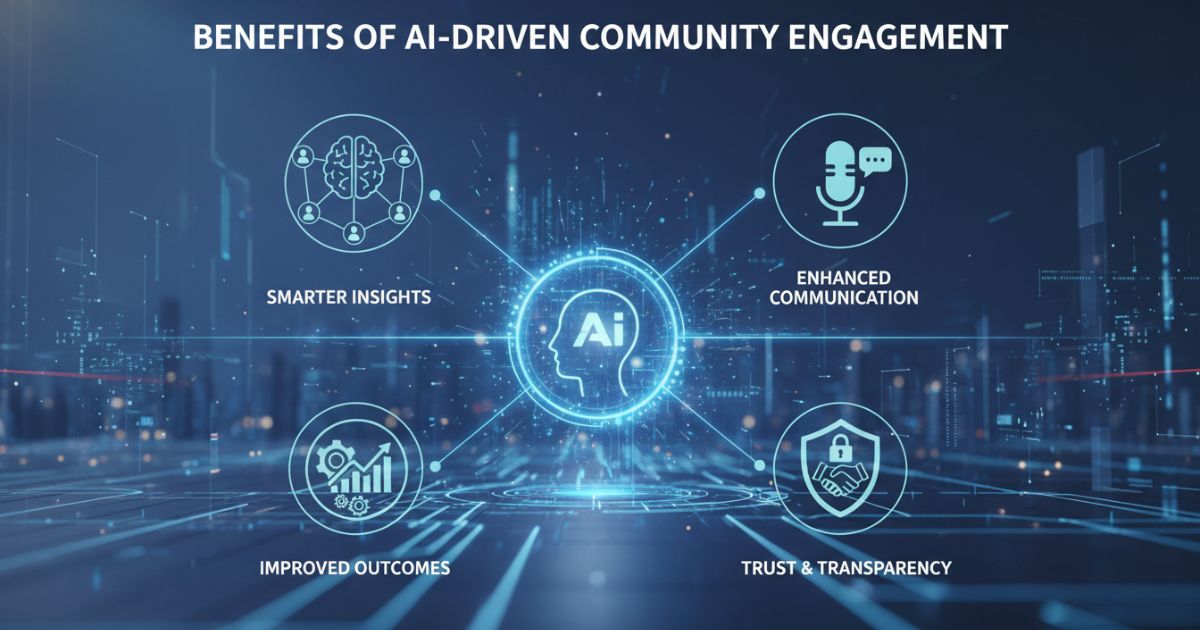
AI-driven community management delivers measurable improvements in engagement metrics. Communities using AI tools report higher member retention rates and increased daily active users. Automated responses reduce wait times for member support, improving overall satisfaction.
Personalization engines help members find relevant content faster. When people see discussions that match their interests, they’re more likely to participate actively. This creates positive feedback loops that strengthen community bonds.
AI tools free up human moderators to focus on strategic initiatives. Instead of manually reviewing every post, staff can concentrate on building relationships and planning community events. This shift from reactive to proactive management improves community culture.
Scalability becomes achievable for growing communities. AI systems handle increased member volume without proportional staff increases. This allows successful communities to expand while maintaining quality member experiences.
How AI Enhances Trust and Safety in Online Communities
Trust and safety are critical pillars of successful online community management. AI plays a major role in maintaining respectful environments by proactively identifying harmful behavior and enforcing community guidelines consistently.
Unlike manual moderation, AI systems operate in real time, preventing toxic interactions from escalating. This creates a safer space where members feel comfortable expressing ideas and participating openly.
Key ways AI strengthens community trust:
-
Real-time detection of hate speech, harassment, and spam
-
Consistent enforcement of community rules without favoritism
-
Early identification of conflict-prone discussions
-
Reduced moderator burnout through automated safety checks
When members feel protected, community participation naturally increases, leading to stronger engagement and loyalty.
Challenges and Considerations
Privacy concerns arise when AI systems collect and analyze member data. Communities must balance personalization benefits with member privacy expectations. Clear data policies and opt-out options help maintain member trust while leveraging AI capabilities.
Algorithm bias can create unfair treatment of certain member groups. AI systems may inadvertently discriminate based on language patterns, cultural differences, or engagement styles. Regular auditing and diverse training data help minimize these issues.
Over-automation risks creating sterile community experiences. Members value authentic human connections alongside AI efficiency. The challenge lies in finding the right balance between automated assistance and human touch.
Technical complexity can overwhelm smaller community teams. Implementing AI tools requires technical knowledge and ongoing maintenance. Community managers need training and support to use these systems effectively.
Ethical AI Practices in Online Community Management
As AI becomes more embedded in online communities, ethical implementation becomes essential. Responsible AI use ensures fairness, transparency, and respect for member privacy while maintaining engagement efficiency.
Community managers must actively monitor how AI systems make decisions and how data is collected and used. Ethical AI strengthens credibility and builds long-term trust with members.
Best practices for ethical AI community management include:
-
Clear disclosure of AI-powered features and automation
-
Regular audits to identify algorithmic bias
-
Allowing members control over personalization settings
-
Protecting user data with strong privacy policies
Ethical AI use ensures that technology supports community values rather than undermining them.
The Future of Online Community Management with AI
The future of Online Community Management will be shaped by increasingly intelligent and intuitive AI technologies. Advances in natural language processing will allow AI systems to better understand member intent, emotions, and conversational context. As a result, AI-powered assistants will deliver more accurate, helpful, and human-like responses that enhance everyday community interactions.
Online Community Management will also evolve beyond text-based engagement. Voice and video analysis will enable AI to interpret tone, emotion, and non-verbal cues within multimedia content. This capability will support more empathetic moderation, improved conflict resolution, and deeper understanding of member sentiment across different communication formats.
Predictive AI will play a central role in the next generation of Online Community Management. By analyzing behavior patterns and engagement signals, AI systems will anticipate member needs before they are explicitly stated. Communities will benefit from proactive content recommendations, smarter member matchmaking, and timely engagement prompts that strengthen participation and satisfaction.
Finally, tighter integration between AI tools will create unified Online Community Management ecosystems. Moderation, analytics, engagement, and personalization systems will work together seamlessly, providing holistic insights and coordinated actions. This connected approach will empower community managers to respond more effectively to evolving community dynamics and build stronger, more resilient digital communities.
The Role of AI in Scaling Online Community Growth

As online communities grow, maintaining quality engagement becomes increasingly challenging. AI-powered community management enables scalable growth without sacrificing member experience or culture.
AI systems adapt to increasing member volume by managing conversations, surfacing valuable content, and maintaining order. This scalability allows communities to expand confidently while staying organized and welcoming.
AI-driven scalability advantages include:
-
Handling high volumes of posts and interactions efficiently
-
Maintaining consistent moderation across large member bases
-
Identifying emerging leaders and active contributors
-
Supporting global communities across time zones
With AI support, community growth becomes sustainable rather than overwhelming.
Implementing AI in Your Online Community Management Strategy
Successful Online Community Management begins with clearly defined objectives for AI adoption. Identify the specific challenges AI can solve, such as reducing manual moderation workload, improving member onboarding, or enhancing content discovery. Prioritizing high-impact areas ensures that AI-driven tools deliver measurable value to your community.
When implementing AI for Online Community Management, choose platforms that integrate smoothly with your existing community software. User-friendly tools that require minimal technical expertise allow teams to adopt AI gradually. Start with foundational features like automated responses and content tagging before expanding to advanced capabilities such as predictive analytics and member behavior insights.
Training and upskilling are essential for effective AI-powered Online Community Management. Community managers must understand how AI systems function, recognize limitations and potential bias, and know when human intervention is necessary. Ongoing education helps maintain a balance between automation and authentic human engagement.
Why Online Community Management Needs AI Today
Modern online community management demands speed, personalization, and insight. Manual approaches alone can no longer keep up with growing member expectations and platform complexity. AI fills this gap by providing real-time intelligence and automation.
By combining human empathy with AI efficiency, community managers can deliver richer experiences while staying responsive and strategic.
Why AI is now essential for community leaders:
-
Rising expectations for instant engagement
-
Increasing content volume and moderation needs
-
Demand for personalized member experiences
-
Need for data-driven decision-making
AI is no longer optional—it is a competitive advantage in community building.
Building Stronger Communities Through AI

AI-powered community management is shifting the approach from reactive moderation to proactive engagement. The future of online community building depends on integrating AI thoughtfully to enhance human connection, not replace it. Community managers who leverage AI tools for engagement while nurturing authentic relationships with members can cultivate stronger, more vibrant digital communities.
Achieving success requires striking the right balance between automation and human touch. AI can efficiently handle repetitive tasks—like content moderation, spam detection, and automated responses—freeing community managers to focus on strategic initiatives, relationship building, and fostering meaningful interactions. This approach allows communities to scale smoothly while preserving the personal connections that make digital spaces valuable.
Consider ways AI can enhance your member engagement strategy. Start with small, proven AI community management tools, measure results carefully, and expand AI adoption based on member behavior and feedback. By using AI to amplify human-led community efforts, rather than replace them, you can create online spaces that are engaging, dynamic, and resilient.
Conclusion
Online Community Management has evolved significantly with the adoption of AI-powered technologies. Artificial intelligence enables community managers to automate moderation, personalize member experiences, and gain deeper insights into user behavior. By reducing manual workload and improving engagement strategies, AI helps communities remain active, safe, and scalable.
The most successful approach to Online Community Management combines AI efficiency with human judgment. While AI handles repetitive and data-intensive tasks, human managers focus on relationship building, trust, and long-term growth. When implemented responsibly and transparently, AI becomes a powerful tool for building stronger, more connected online communities.
FAQs: Online Community Management
1. What is Online Community Management?
Online Community Management is the practice of building, managing, and nurturing digital communities by engaging members, moderating discussions, and providing ongoing support. The goal is to encourage interaction, build trust, and drive long-term community growth.
2. How does AI support Online Community Management?
AI supports Online Community Management by automating repetitive tasks such as moderation and responses, analyzing member behavior, and delivering personalized content. This allows community managers to operate more efficiently and focus on strategic initiatives.
3. Can AI replace human community managers?
No. AI cannot replace human community managers. While AI handles routine and data-driven tasks, human managers are essential for emotional intelligence, conflict resolution, community culture, and relationship building.
4. What AI tools are commonly used in online communities?
Common AI tools include chatbots for member support, AI-powered moderation systems, content recommendation engines, sentiment analysis tools, and member behavior analytics platforms.
5. Is AI-powered community management suitable for small communities?
Yes. AI-powered community management is highly scalable and suitable for small communities, helping them manage engagement, moderation, and onboarding with limited resources while maintaining quality experiences.
6. How does AI improve community engagement?
AI improves engagement by recommending relevant content, personalizing user experiences, identifying trending topics, and helping members connect with like-minded individuals within the community.
7. What role does AI play in content moderation?
AI plays a critical role in content moderation by detecting spam, harassment, hate speech, and policy violations in real time. This helps maintain a safe, respectful, and welcoming community environment.
8. Are there privacy concerns with AI in Online Community Management?
Yes. Privacy concerns exist when AI systems collect and analyze member data. Communities must be transparent, protect user data, and comply with data protection laws to maintain member trust.
9. How can communities avoid over-automation?
Communities can avoid over-automation by maintaining human oversight, reviewing AI decisions regularly, and ensuring that meaningful interactions still involve real people.
10. Can AI help reduce member churn?
Yes. AI uses predictive analytics to identify disengaged or inactive members early, allowing community managers to apply targeted re-engagement strategies before members leave.
11. How does AI help community managers make better decisions?
AI provides data-driven insights into member behavior, engagement patterns, content performance, and community health, enabling more informed and strategic decision-making.
12. How should organizations start using AI for Online Community Management?
Organizations should begin with clear objectives, adopt simple AI tools first, train community teams properly, and continuously monitor performance while gathering member feedback for improvement.