
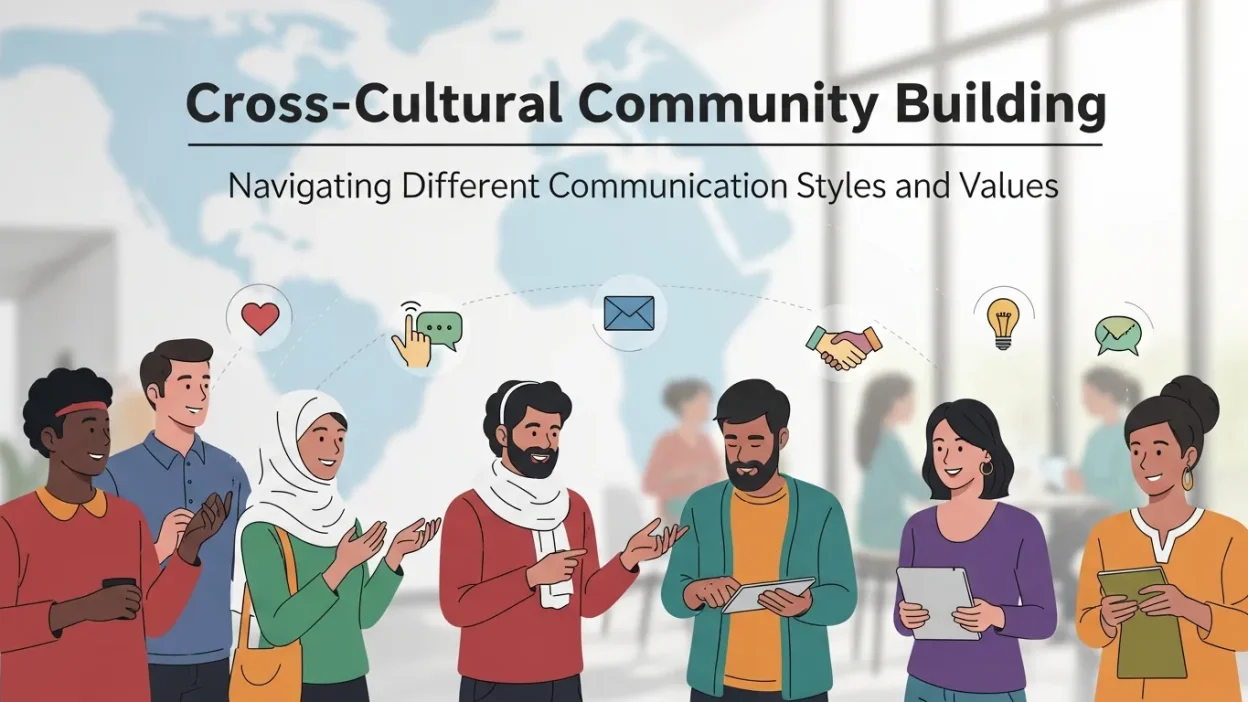
Building a Cross-Cultural Community requires understanding differences in communication, leadership, and values. Without awareness, these differences can cause misunderstandings. However, when communities embrace inclusion and move beyond stereotypes, diversity becomes a strength. A strong Cross-Cultural Community builds trust, creativity, and resilience by genuinely integrating diverse cultural perspectives.
Building a cross-cultural community takes understanding, respect, and clear communication. People from different backgrounds often have unique ways of expressing ideas, making decisions, and solving problems. Recognizing these differences is key to creating inclusive spaces where everyone feels valued. Cultural diversity brings new perspectives, strengthens collaboration, and fosters creativity. Inclusive communication and intercultural understanding help prevent misunderstandings and build trust. Communities that embrace diversity encourage active participation, shared values, and meaningful community engagement. By learning how to navigate different communication styles and cultural norms, leaders can create stronger, more connected communities.
The Cultural Foundations of Community
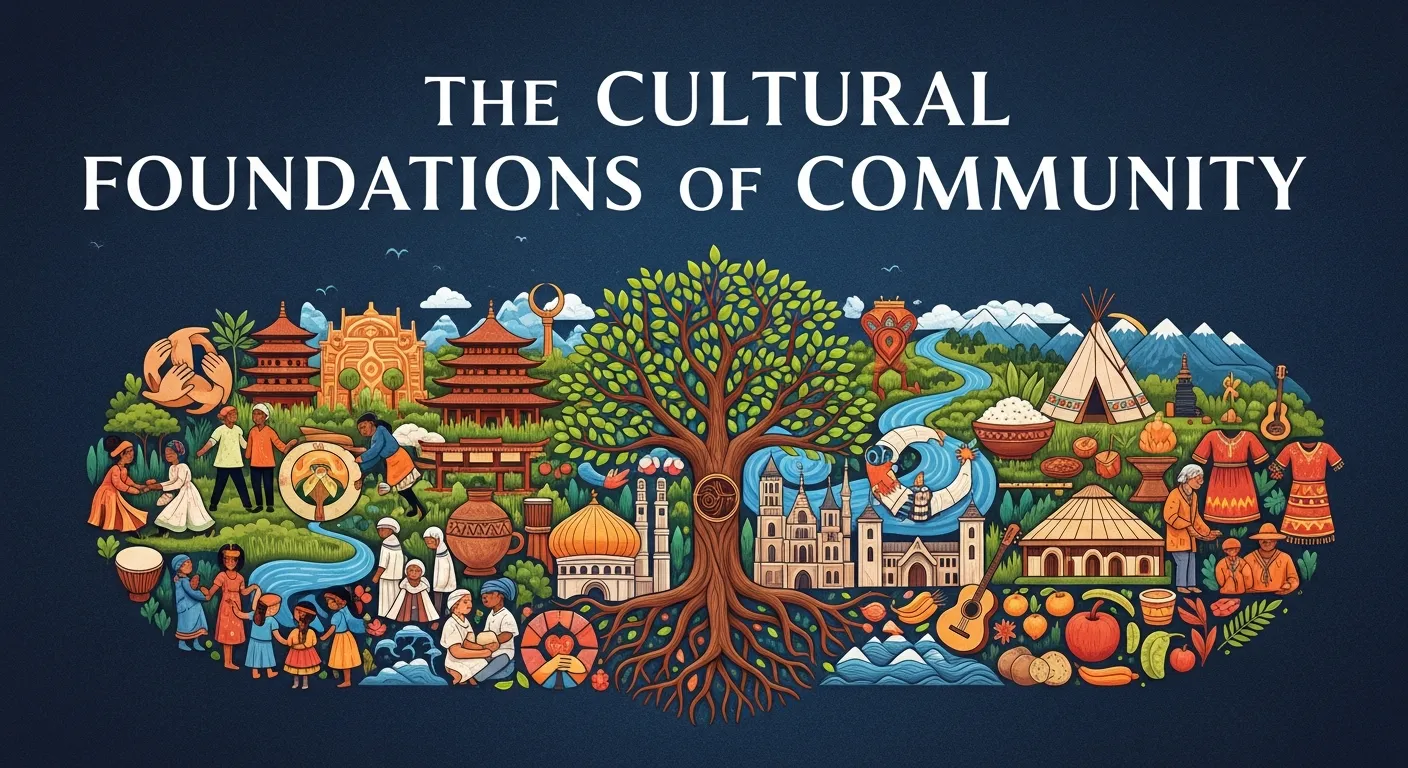
Communities function through shared understanding—often unspoken—about appropriate communication, leadership, participation, and values. When community members bring different cultural frameworks to these fundamental elements, misalignment can trigger confusion, frustration, and disengagement.
Cultural anthropologist Edward T. Hall famously distinguished between high-context and low-context cultures of communication. In high-context cultures (including many East Asian, Middle Eastern, and Latin American societies), meaning often resides in environmental cues, shared history, and nonverbal signals. In low-context cultures (including many Northern European and North American settings), explicit verbal expression carries primary importance.
These differences become particularly evident in community settings. A Japanese-American woman in a community forum might express disagreement through silence or subtle qualifications, while her German-American counterpart states objections directly. Without cultural awareness, each might misinterpret the other’s approach—seeing either rudeness or dishonesty where neither exists.
Similar variations appear in other dimensions of community interaction:
Time orientation varies dramatically across cultures, with some prioritizing punctuality and linear schedules while others emphasize flexibility and relationship-centered timing.
Decision-making processes range from hierarchical to consensus-based, reflecting deeper cultural values around authority and individualism.
Conflict approaches span confrontation, third-party mediation, and indirect accommodation, depending on cultural norms around harmony and face-saving.
According to research from the Intercultural Communication Institute, these differences frequently undermine cross-cultural community initiatives long before participants recognize the cultural foundations of their disconnection.
Beyond Cultural Stereotypes
While understanding broad cultural patterns provides valuable context, effective cross-cultural community building requires moving beyond generalizations to engage with individuals on a personal level. Cultural frameworks offer starting points for understanding, rather than rigid boxes for categorizing community members.
“The danger lies not in recognizing cultural differences but in assuming they determine individual behavior,” explains Dr. Milton Bennett, founder of the Intercultural Development Research Institute. “Cultural awareness should expand rather than limit our perception of others.”
This nuanced approach proved essential when I consulted with a faith community that was navigating the integration between its established English-speaking congregation and a growing Spanish-speaking membership. Initial attempts at inclusion focused exclusively on language translation, overlooking more profound differences in worship expectations, leadership structures, and community celebration styles. Progress began only when leaders stopped seeing “Hispanic ministry” as a monolithic category and started engaging with the specific cultural backgrounds and individual preferences within their diverse Spanish-speaking membership.
Building Communication Bridges
Thriving cross-cultural communities develop multilingual approaches to communication—not just in the literal sense of language translation but in adapting to different cultural communication styles. This adaptability begins with awareness but must evolve into concrete practices.
Cross-cultural communication flourishes when communities implement several key strategies:
Create multiple feedback channels that accommodate different comfort levels, allowing for direct expression. When the multinational tech company I worked with supplemented their traditional town hall meetings with anonymous suggestion systems and small-group discussions, participation from their East Asian team members increased dramatically.
Establish explicit communication norms while acknowledging their cultural foundations. A community organization serving recent immigrants developed a simple “ways we talk together” guide that explained typical American meeting behaviors while validating alternative approaches.
Train facilitators in cross-cultural communication patterns, enabling them to recognize when cultural differences might be driving apparent conflicts or misunderstandings.
Rotate meeting structures to incorporate different cultural approaches to decision-making and discussion. A university student organization alternated between direct-agenda meetings familiar to Western students and relationship-building circular discussions preferred by indigenous members.
Develop visual communication systems that transcend both language barriers and cultural communication styles. Graphic recording of community discussions helps bridge understanding across verbal communication divides.
Values Alignment Across Cultural Differences
Beyond communication styles, cross-cultural communities must navigate different value systems. These differences rarely involve completely opposing values—most cultures value concepts like respect, family, and fairness. However, they often prioritize and express these values differently.
For instance, most cultures value respect, but its expression varies dramatically. In specific settings, questioning authority demonstrates intellectual engagement and a respect for the truth. In others, the same behavior communicates disrespect for established wisdom and hierarchy. Neither approach is inherently superior; however, misalignment can create community friction when interpreted through different cultural lenses.
The Cultural Intelligence Center has documented how successful cross-cultural organizations focus on translating values rather than imposing them. This approach involves identifying the underlying shared values even when their expressions differ.
I observed this approach transform a struggling multicultural neighborhood initiative. Rather than debating whose cleanliness standards should prevail in shared spaces, facilitators redirected the discussion toward the shared value of creating welcoming environments. This reframing enabled participants to recognize their shared goal, despite different cultural expressions of hospitality and orderliness. Learn More Community Economics
Creating Cultural Bridges Through Structure
While awareness and goodwill provide necessary foundations, successful cross-cultural communities require intentional structures that bridge differences. These structures take many forms:
Cultural liaisons who help interpret both explicit and implicit communication across groups. When a community development organization I worked with appointed respected members from different cultural backgrounds as designated connectors, inter-group communication improved dramatically.
Transparent decision frameworks that clarify how input translates into action across cultural expectations. A neighborhood association developed a simple visual system showing which decisions required consensus, which used majority voting, and which fell to designated leaders.
Multilingual documentation that goes beyond literal translation to incorporate culturally resonant concepts and examples. A parent-teacher organization found that direct translation of their materials into Mandarin failed to convey their collaborative intent until they incorporated culturally appropriate educational metaphors.
Intentional social spaces where relationships can develop across cultural boundaries. A housing cooperative struggling with cultural divisions established monthly potluck dinners featuring foods from residents’ backgrounds, creating neutral territory for cross-cultural relationship formation.
Cultural orientation for new community members that explicitly addresses unstated expectations. A professional network developed culture-specific welcome materials explaining typical American networking behaviors that often confused international members.
The Developmental Journey of Cross-Cultural Communities
Cross-cultural competence doesn’t emerge overnight—either for individuals or communities. Development typically progresses through distinct phases requiring different support strategies.
In early stages, communities often exhibit polarization between cultural approaches, with members advocating for their familiar norms. During this phase, external facilitation and structured interaction across cultural lines prove essential.
As understanding grows, communities typically enter a phase of minimization, where members emphasize similarities while downplaying significant differences. This stage requires a deeper understanding of meaningful cultural variations to prevent superficial engagement.
Mature cross-cultural communities eventually develop integration capacity—the ability to adapt approaches based on situation rather than defaulting to any single cultural framework. At this stage, leadership often emerges organically from previously marginalized groups as the community values diverse cultural contributions.
This developmental progression explains why many cross-cultural initiatives struggle initially despite good intentions. The Tennessee immigrant support network I advised initially interpreted early conflicts as failures rather than recognizing them as normal developmental stages in cross-cultural community building.If you want to learn more about traditional marketing, you can read further.
Beyond Tokenism Toward True Inclusion
Genuine cross-cultural community building transcends superficial efforts at diversity. Where tokenism seeks visible representation without structural change, authentic inclusion involves rethinking fundamental community processes to incorporate diverse cultural wisdom.
A business association I worked with initially approached cultural diversity through specialized marketing committees representing different ethnic communities. While well-intentioned, this approach maintained their traditional structure while adding cultural representatives at the margins. Transformation began when they reconsidered their entire governance system, incorporating different cultural approaches to leadership and decision-making into their core functions.
Proper cross-cultural integration often requires examining unrecognized cultural assumptions embedded in seemingly neutral community structures. Meeting times, childcare arrangements, food practices, technology platforms, and participation expectations all carry cultural fingerprints that may unintentionally exclude certain groups.
When a community arts organization I consulted with struggled to attract diverse participation, they discovered their evening meeting schedule effectively excluded members from cultures with stronger family dinner traditions. Their application process, requiring written personal statements, disadvantaged cultures with stronger oral traditions. Neither practice was intentionally exclusionary, but both reflected unconsidered cultural defaults.
The Intercultural Community Advantage
Despite their challenges, cross-cultural communities that successfully navigate differences gain significant advantages over culturally homogeneous groups. Research consistently shows that culturally diverse teams outperform homogeneous ones in problem-solving, innovation, and adaptability—provided they develop effective integration methods.
These benefits extend beyond practical outcomes to create communities with distinctive resilience and vitality. Cross-cultural communities expose members to multiple ways of understanding and navigating the world, expanding everyone’s behavioral repertoire and cognitive flexibility.
The international cohousing community I visited demonstrated this advantage during an unexpected construction crisis. Their multicultural membership drew on Japanese approaches to consensus, German engineering precision, and Brazilian creative adaptation—combining cultural strengths that no monocultural community could access.
Starting Where You Are

Creating cross-culturally fluent communities begins with assessing current cultural patterns and identifying bridges toward greater integration. This process typically involves several key steps:
- Cultural mapping to identify which cultures significantly influence your community’s composition and dynamics.
- Pattern recognition to understand how cultural differences manifest in specific community contexts.
- Structure evaluation to detect unintended cultural barriers in existing community systems.
- Leadership development that equips diverse members to guide community evolution.
- Communication expansion to incorporate multiple cultural styles into community discourse.
For existing communities seeking greater cultural fluency, these steps often require external facilitation to illuminate blind spots. For new communities, incorporating cross-cultural awareness from the outset can help prevent the entrenchment of particular cultural defaults as “normal” community behavior.
The journey toward cross-cultural community competence rarely proceeds smoothly. Yet communities that persist through initial misunderstandings and structural adjustments discover something remarkable: the very tensions that initially threatened cohesion often become sources of distinctive community strength. By incorporating diverse cultural wisdom into their fundamental operation, these communities develop resilience, creativity, and human connection that transcends what any single cultural approach could achieve alone.
Conclusion
A strong Cross-Cultural Community does not emerge by accident—it is built through awareness, adaptability, and structural inclusion. By recognizing different communication styles, value systems, and leadership expectations, communities can prevent unnecessary conflict and promote deeper engagement. True inclusion goes beyond token representation; it requires reshaping systems to reflect diverse cultural wisdom. Although the journey may include challenges and misunderstandings, communities that persist gain innovation, resilience, and stronger human connections. Ultimately, a Cross-Cultural Community transforms diversity from a potential source of division into a lasting source of collective strength.
FAQs – Cross-Cultural Community
1. What is a Cross-Cultural Community?
A Cross-Cultural Community is a group of people from diverse cultural backgrounds who interact, collaborate, and build shared understanding while respecting cultural differences.
2. Why is Cross-Cultural Community important?
It promotes inclusion, strengthens collaboration, increases creativity, and prepares communities to function effectively in a globalized world.
3. What challenges arise in a Cross-Cultural Community?
Common challenges include communication misunderstandings, different conflict styles, varied leadership expectations, and contrasting value expressions.
4. How do communication styles differ across cultures?
Some cultures use indirect, high-context communication, while others rely on direct, explicit verbal expression. These differences can affect discussions and decision-making.
5. How can leaders strengthen a Cross-Cultural Community?
Leaders can create inclusive communication channels, clarify expectations, provide cultural orientation, and encourage active participation from diverse members.
6. What is the role of cultural awareness in community building?
Cultural awareness helps prevent misinterpretations, reduces bias, and builds mutual respect among members.
7. How does diversity improve a Cross-Cultural Community?
Diversity introduces new perspectives, improves problem-solving, enhances innovation, and increases adaptability.
8. What is the difference between diversity and inclusion?
Diversity refers to representation of different cultures, while inclusion ensures those cultures actively influence decisions and feel valued.
9. How can communities prevent cultural stereotyping?
By engaging individuals personally, avoiding assumptions, and recognizing cultural frameworks as flexible rather than fixed categories.
10. Why is structural change important in a Cross-Cultural Community?
Without structural adjustments, communities may unintentionally favor one cultural norm over others, limiting true inclusion.
11. How does conflict resolution vary across cultures?
Some cultures prefer direct confrontation, while others favor mediation or indirect communication to maintain harmony.
12. What is the long-term benefit of building a Cross-Cultural Community?
A well-developed Cross-Cultural Community gains resilience, stronger relationships, broader understanding, and sustainable collective growth.